Author Archives: Ken Ekechukwu

Case 4: Retrieving IVC filters. Ken U. Ekechukwu, MD, MPH, FACP.

Help essay writing

Hemodialysis Access, Case 6. Ken U. Ekechukwu, MD, MPH, FACP.

Clinical problem: A  43-year-old male patient with end-stage renal disease was referred to the interventional radiology service for a new dialysis access and relief of signs of superior vena cava syndrome. He had had many failed autogenous and non-autogenous arteriovenous accesses, and recently reverted to tunneled dialysis catheters as he waited for new arteriovenous access. Most recently, he suffered cardiac arrest at another facility while receiving a tunneled dialysis catheter.

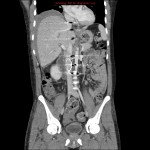
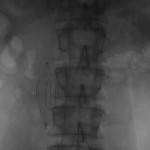
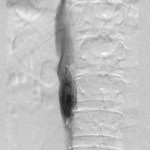
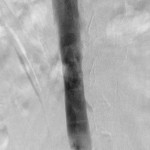
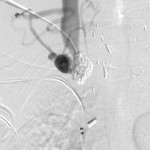
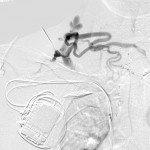
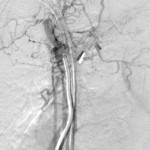
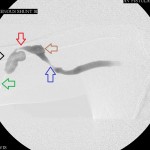
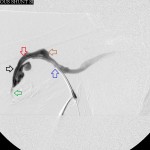
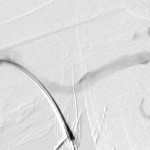
Angiographic findings: There is chronic total occlusion of the distal right internal jugular vein (RIJV), right external jugular vein (REJV), right brachocephalic vein (RBCV), and the superior vena cava from previous catheterizations. The occlusions prevent the insertion of a new catheter by conventional means. Other findings from other imaging modalities revealed occlusions of the common femoral and iliac veins as well as the SVC.

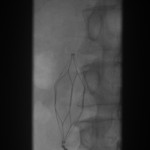
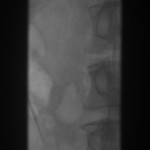
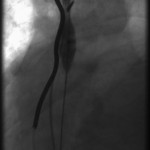
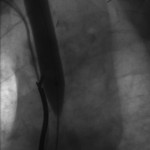
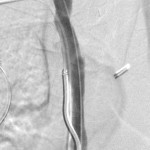
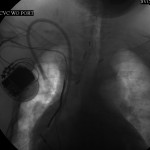
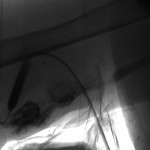
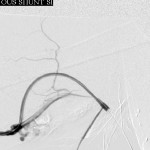
Endovascular interventions: The distal right internal jugular vein was identified with a high-frequency ultrasound probe and accessed with a micropuncture set. Venogram through the access revealed complete occlusion of the distal end of the vein as well as collaterals at the root of the right neck. It was not possible to pass a guidewire through the access into the right atrium, so a second access was gained into the right external jugular vein under ultrasound guidance. Central venogram through this access showed it was also completely occluded, but it was possible to probe through it into the right atrium with a stiff guidewire and a catheter. With the stiff guidewire advanced through this access into the inferior vena cava, a balloon was used to dilate the occluded venous track. After confirming that the lumen of the vessel was restored, a double-lumen, cuffed catheter was advanced into the right atrium and retrogradely tunneled through the upper right chest and out the skin. The final chest radiograph shows the well-curved catheter in the right atrium. 

Practical points:

  1. It is possible to recanalize chronic venous occlusions, even when such prospect seems bleak.
  2. Such occlusions result from previous central venous catheterizations or manipulations. The presence of cardiac electrodes through the right subclavian vein in this patient did not help matters.
  3. Such occlusions when bilateral and total can cause superior vena cava syndrome, whose symptoms may be pronounced by fluid retention when the occlusions preclude dialysis and there no other means for dialysis. 
  4. Recanalizing such occlusions can be life-saving when there are no other ways to dialyze a patient.

Hemodialysis Access, Case 5. Ken U. Ekechukwu, MD, MPH, FACP.

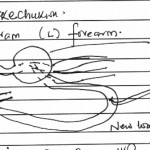
Clinical problem: 44-year-old man who had had multiple failed arteriovenous accesses in the past. His new left forearm non-autogenous brachiobrachial access did not work well at his most recent hemodialysis session.

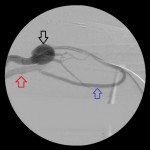
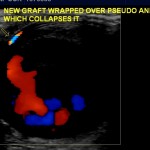
Findings at imaging: The angiogram shows a loop arteriovenous graft connecting the distal left brachial artery to the proximal left brachial vein. The artery, the graft, and the vein are patent, the vein yet to mature. A large aneurysm overlays the distal left brachial artery, obscuring the arterial anastomosis of the graft and the effect of the aneurysm, if any, on the juxta-anastomotic graft. Axial color Doppler view of the aneurysm confirms a massive, swirling structure with a turbulent interior. The arrow at its 11:00 position identifies the juxta-anastomotic segment of the graft, partially collapsed by the aneurysm.

Intervention: The patient was referred to vascular surgery for aneurysmectomy, which corrected the problems at dialysis. The mass proved to be a pseudoaneurysm of the distal brachial artery thought to be iatrogenic.

Hemodialysis Access Maintanance, Case 4. Ken U. Ekechukwu, MD, MPH, FACP.

Clinical problem: Failed right brachiobrachial fistula.

Angiographic findings:

  1. A high-grade juxta-anastomotic venous stenosis.
  2. 2 upstream venous aneurysms between which is sandwiched  a 2nd high-grade venous stenosis.
  3. A 3rd venous stenosis, also high-grade, distal to the distal aneurysm.
  4. Venous collaterals around the right axillary vein due to chronic total occlusion of the right subclavian vein.

Challenges: Many lesions clustered within a short venous segment with little room for intervention. Accessing the normal downstream brachial vein was difficult because there wasn’t much room between the patient’s chest wall and the right arm.

Intervention

  1. The proximal right brachial vein was accessed with ultrasound guidance, the needle pointing towards the central veins, and the access secured with a sheath.
  2. A balloon was advanced to the distal venous stenosis and inflated, eliminating the stenosis.
  3. A second access was secured into the downstream brachial vein, pointing towards the right hand, through which the balloon was passed to the juxta-anastomotic and inter-aneurysmal stenoses and inflated.
  4. Reflux angiography of the access circuit was performed and revealed normal arterial limb of the circuit.
  5. Final angiography of the venous limb of the circuit revealed resolved stenoses.
  6. No action was taken on the aneurysms at this session.
  7. The subclavian occlusion was not addressed because it did not seem to contribute to the failure of the access.


Hemodialysis Access Maintenance: Case 3. Ken U. Ekechukwu, MD, MPH, FACP.

I use this case to illustrate when to end an intervention and avoid harming the patient. “Better is the enemy of good” is a truism among interventional radiologists. In trying to improve the outcome of an intervention by doing more, terrible things may happen and foul earlier efforts.

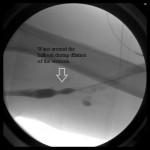
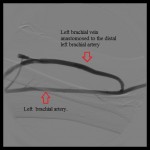
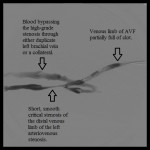
This was a patient with a failed arteriovenous fistula (AVF) between the proximal left brachial vein and the distal left brachial artery. Pullback venogram recorded from the central veins to the mid left brachial vein revealed normal central veins, a smooth, short critical stenosis of the distal left brachial vein, and clot in the proximal left brachial vein.

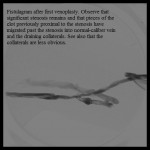
After pharmachomechanically clearing the thrombosed proximal segment of the venous limb of the fistula, I used a non-compliant balloon to dilate the distal stenosis. It is conventional to oversize balloons for venoplasty by 10% to 20% in recognition of the odd behavior of the scar tissue and abnormal smooth muscle encircling the strictured venous segment, at the same time being careful to avoid rupturing the vein during the inflation. It is common knowledge that the shadow of the lumen of the treated segment is often cosmetically unappealing soon after angioplasty and there is urge to improve such appearance by inflating the segment with larger balloons. It is not uncommon that such zeal is rewarded with a tear or rupture of the vein.

If this happens one may do one of a few things:

  1. They may tamponade the bleeding by inflating a balloon across the tear for a few minutes. This may be sufficient, but risks re-thrombosing the proximal segment of the vein if it has already been cleared of clot. In fact this is one reason some interventionists address downstream venous stenoses before clearing clot in the proximal venous limb.
  2. If balloon tamponade does not stop the bleeding, the access can be intentionally re-thrombosed by compressing the portion of the vein (or graft) proximal to the tear. This should be a last resort and should be done only when isolating the injury with a covered stent is infeasible.
  3. If a covered stent is available and balloon tamponade of the tear has failed, the tear may be isolated from the circulation with a covered stent.

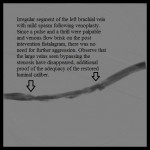
It is preferable to avoid such complication by accepting some irregularity and residual stenosis (<30%) of the vein after angioplasty, recognizing that some of the spasm is physiologic response to the balloon inflation that resolves on its own or after intravenous injection of nitroglycerin. In addition, noting the presence of certain features that prove adequate intervention may be reassuring reason to end the procedure. These include:

  1. Resolution of collaterals associated with the stenosis before the intervention(s).
  2. Palpating a pulse or feeling a thrill where none was present before.
  3. Observing improved rate of venous flow on the post-intervention examination relative to the pre-intervention examination.