

Author Archives: Ken Ekechukwu

Peripheral Arterial Disease (PAD)

What is peripheral arterial disease PAD?
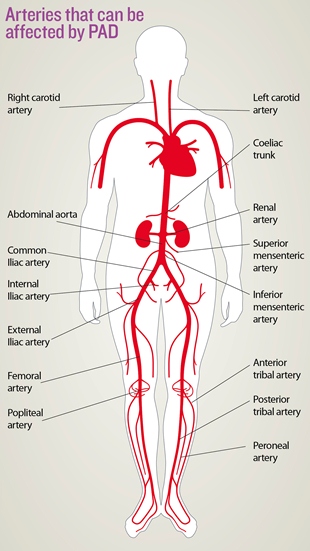
Peripheral arteries of the body

Peripheral arteries of the body

All arteries that do not supply the heart or directly supply the brain are peripheral arteries. This diagram to your left shows these arteries. Many conditions can affect the walls of these arteries and cause the arteries to narrow or obstruct. This is peripheral arterial disease. Common conditions that increase a person’s risk of peripheral arterial disease are smoking, advanced age, diabetes mellitus, hyper- tension, hypercholesterolemia and male sex. Other  situations or conditions include a family history of PAD, being overweight, an inactive life style, and past history of stroke or heart attack.

What problems can PAD cause?

It depends on the area of the body PAD affects.

  1. PAD of the large arteries in the neck can cause stroke.
  2. PAD of the kidney arteries cause hypertension and may lead to kidney failure.
  3. PAD of the arteries that supply the intestines can cause pain after meals, malabsorption, and weight loss.
  4. PAD of the arteries that supply the legs and feet can cause pain when walking as well as foot ulcers and gangrene when extreme. These can lead to amputa- tion of the leg or foot.
  5. PAD of the abdominal aorta can cause aneurysm that may rupture and cause death.
  6. PAD of the arteries that supply the penis may cause erectile dysfunction.
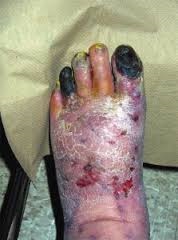
Gangrene by PAD
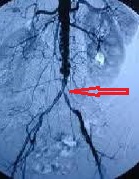
Gangrene by PAD

Narrow aorta by PAD

Narrow aorta by PAD


How do I know I have PAD?

If you have any of the conditions or lifestyles listed above, you have a higher chance of having PAD and if you have any of the symptoms or manifestations of the disease, consider seeing your physician. There are tests that will confirm or dismiss the disease in you, and if proven to have it, you will be referred to healthcare specialists to help you.

Is there treatment for PAD?

Yes, there is treatment for PAD. It starts with prevention: stopping smoking, better control of the blood sugar, cholesterol, and hypertension with medication reduce the risk of developing PAD and slow down its progression. But when the disease is advanced and causes much problem like leg cramping when walking or ulcer and gangrene of the feet, the narrow or obstructed artery can be bypassed by a surgeon in an operation. It can also be reopened by a vascular specialist like an interventional radiologist with special instruments that remove the obstruction or prop the artery open (stents).
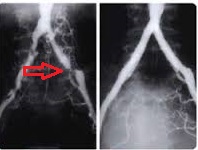
Iliac PAD before + after stenting
Iliac PAD before + after stenting
Maintenance Of Hemodialysis Accesses.

What Are Hemodialysis Accesses?

The kidneys eliminate excess water and impurities from the body. When they fail the body retains the impurities and water making the patient sick. The best treatment for renal failure is renal transplant, but for several reasons this is not always practicable. 2 substitutes, hemodialysis and peritoneal dialysis are available to keep patients alive.

In peritoneal dialysis the membrane lining the patient’s abdominal cavity exchanges the impurities and excess water with a liquid called a dialysate injected into the cavity through a catheter inserted into it.

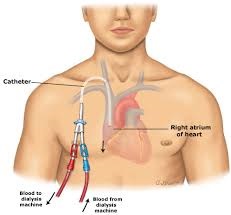
Dialysis catheter

Dialysis catheter

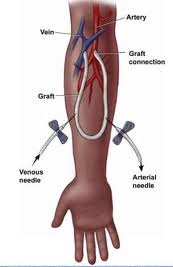
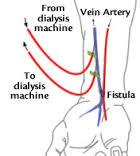
In hemodialysis, blood drawn from the patient is passed through a machine that removes the impurities and excess water and returned to the patient’s blood stream. A catheter with 2 channels is inserted into a large vein in the patient by an interventional radiologist and blood is drawn through one channel to the dialyzing machine and returned to the patient from the machine through the second channel. In another method of hemodialysis, surgeons connect an artery to a vein either directly in arteriovenous fistulas (AVFs) or by interposing an artificial tube between them in arteriovenous grafts (AVGs).


AV Fistula

AV Fistula

AV Graft

AV Graft

Blood is drawn from and returned to the patient through these channels after passing through a dialyzing machine. Catheters, AVFs, and AVGs are all hemodialysis accesses, but AVFs and AVGs are more desirable than dialysis catheters.


Do Hemodialysis Accesses Fail?

Yes, they fail or malfunction, but there several things interventional radiologists do to restore their function. The dialysis catheter may leak, break, obstruct, or become infected. Usually, every effort is made to preserve the access unless doing so imperils a patient. When that is the case, the catheter may be exchanged for a new one using the same venous access, or a new venous access created if using the old access is unwise or not practicable.

AVFs and AVGs may fail to ‘mature’ after their creation and be unusable. Interventional radiologists can assist their maturation with creative interventions. But their commonest problem when mature is their unpredictable, sudden cessation to function. This is often due to a narrowing in their venous limb that develops over time, slowly diminishing the flow of blood through the access until it suddenly ceases. The blood in the graft and any length of vein before the obstruction congeals, completing the problem. Interventional radiologists have ways of reopening the venous narrowing, removing the blood clot and restoring function to the access. Sometimes these accesses fail because they develop large bulges called aneurysms from being punctured repeatedly. These can also be treated with stents to prolong the life of the access. To avoid these surprises, the accesses are often monitored periodically with ultrasound or angiography.


Uterine fibroid embolization

Before UFE

Before UFE

3mo post UFE

3mo post UFE

Uterine fibroids can cause heavy, painful, erratic menses that cause anemia, easy tired- ness, dizziness, and poor tolerance for exer- cise. Many women with uterine fibroids suffer needlessly,
unaware of minimally-invasive resources to end their misery.One such treatment offered by our specialists is uterine artery embolization in which blood flow to the fibroids is blocked, killing them.


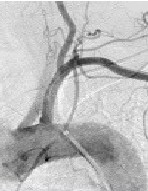
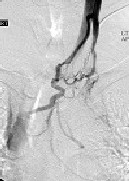
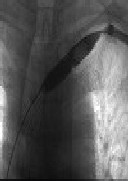
Reopening narrow and blocked arteries and veins.

Before...

Before…

At...

At…

Post stenting

Post stenting

Smoking, diabetes mellitus, hypertension, high blood cholesterol can narrow or obstruct blood flow to the feet, the kidneys, the brain, and the intestines. This may cause the loss of a limb, uncontrolled hypertension, stroke, or abdominal pain after eating, but our specialists use simple tools to treat such problems in minimally-invasive procedures called angioplasty, atherectomy, and stenting.


Before...

Before…

At...

At…

Post stenting

Post stenting

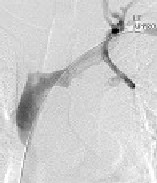
They use similar measures (excluding atherectomy) – called venoplasty and venous stenting – to re-open narrow and occluded veins in the limbs, the abdomen, or the chest. Such venous problems can occur in those who may have worn a catheter in their chest for hemodialysis or for the admin-istration of fluids, drugs, or nutrition and in people who may have had blood clot in their limbs or their veins pressed on or invaded by cancer.


Dialysis Access Maintenance

Patients with kidney failure rely on hemodialysis or peritoneal dialysis to live, if renal transplant is not possible. Those on hemodialysis may have catheters put into them by our specialists or an artery connected to a vein in an area of their body by a vascular surgeon. These accesses are connected to achines that dialyze their blood (remove impurities and water) on set days of the week. The catheters and arteriovenous connections, called dialysis accesses, frequently malfunction or fail and our specialists restore their function.

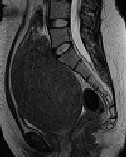
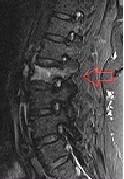
MRI before

MRI before

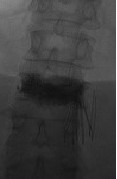
X-ray after

X-ray after


Vertebroplasty and kyphoplasty

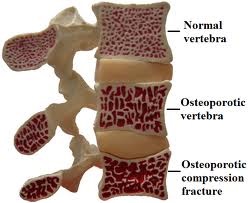
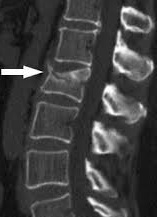
The back bone (vertebral column) may fracture with little or no force in people with osteoporosis or some malignancies of the bone marrow. This can cause unpleasant pain until the fracture heals. The pain can be quickly alleviated or eliminated by us injecting “bone cement” into the injured bone using image guidance.

EVLT, phlebectomy, sclerotherapy for varicose vein.

When valves regulating the drainage of venous blood from the lower limbs are de- fective, the pressure in the veins rises over time and fluid and impurities are inefficiently cleared from the legs. The legs may ache, feel heavy, swell, tire easily during walks, and their surface veins grow wormy.

Percutaneous vertebroplasty & kyphoplasty

What are percutaneous vertebroplasty & kyphoplasty?

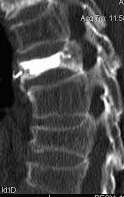
Vertebroplasty is restoring strength to a fractured vertebra (backbone) by injecting a chemical (bone cement) into it through a hollow tube introduced into the bone from the back. The chemical permeates the lacelike spaces in the bone including the fracture planes, hardens, and reinforces it.

Vertebroplasty

Vertebroplasty

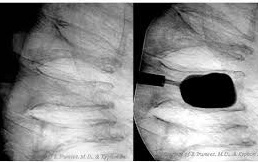
Kyphoplasty

Kyphoplasty

Kyphoplasty is the repair of a hunched back caused by compressed vertebral fracture(s). It is typically achieved by inflating a balloon inserted into the crushed vertebra through in- struments advanced into it from the back. The inflation creates a cavity or space into which bone cement is injected. Thus, not only is the bone stronger, it is ‘taller’ and the back hunch-free. Both procedures are commonly done under cover of conscious sedation (light sedation) and local anesthesia, allowing patients to go home the same day.


What are the indications for vertebroplasty and kyphoplasty?

Osteoporosis

Osteoporosis

Multiple myeloma

Multiple myeloma

The typical patient is one who broke their backbone(s) in a fall or, who through some other means damaged a backbone and whose pain does not respond to adequate pain medication, physical therapy and back braces. Osteoporotic vertebral fractures take 4 weeks to 12 weeks to heal and can be a source of constant back pain and altered lifestyle. Over 80% of people with such painful fractures are pain-free after vertebroplasty or ky- phoplasty. The re-enforced bone remains fit and painfree until another fracture occurs at another level of the spinal column.


Who is at risk for vertebral compression fractures?

People at risk for fractures of the backbone include those with osteoporosis or other medical conditions that weaken the bone, such as multiple myeloma (MM), vertebral hemangioma or metastatic cancer. By far the commonest of thses is osteoporosis, which is commoner in elderly Caucasian females. In this non-malignant condition the amount of calcium in bones is low, placing them at risk for fractures with little or no stress or provocation.

How do I know I need vertebroplasty or kyphoplasty?

If you are an elderly person or someone with any of the conditions referred to above that weaken bones and you have back pain with or without a fall that has not responded to conservative measures, you may wish to see your healthcare provider. Plain x-rays, CT scan, or MRI of your back will help determine if you need to see a specialist such Osteoporosis Multiple myeloma as an interventional radiologist for vertebroplasty or kyphoplasty. People with healed vertebral fractures are unlikely to benefit from these treatments. In such persons, oth- er causes of back pain should be sought. It is for this reason that most practitioners of vertebroplasty and kyphoplasty rely on MRI of the spine to determine if a suspected vertebral fracture is responsible for a patient’s back pain, in addition to it being able to uncover unsuspected reason(s) for such pain.

Uterine Fibroid Embolization

What are fibroids?

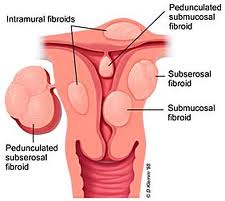
Fibroids are benign tumors of the uterus that have near-zero risk of becoming cancerous. The uterus could have one or several fibroids located in any of its different layers. Like the uterus, the growth of fibroids is influenced by circulating female hormones. For this reason,

uterine fibroids

fibroids and the problems they cause are com- mon in women of child-bearing age. At meno- pause, they die and rarely cause problems.

How do I know that I have uterine fi-broids?

Many women with uterine fibroids do not know they have them, because they do not border them. These women do not need any treatment. Some women may have symptoms caused by fibroids, but believe they are natural menstrual phenomena. These symptoms include heavy and painful periods, unpredictable erratic menses, lower back pain, constipation, painful sex, frequent urination, increased abdominal girth, and reduced ability to conceive or keep pregnancy. The frequent, heavy menstruation may lead to anemia resulting in persistent tiredness, poor exercise tolerance, and air hunger after common exertions. Women with these problems often consult a physician.

Are symptomatic uterine fibroids treatable?

Yes, symptomatic uterine fibroids are treatable. If menopause is near and a woman’s symptoms not major, she may choose to wait for them to resolve at menopause. Options available to women with major complaints include hormonal treatment, myomectomy, endometrial ablation, hysterectomy, and uterine fibroid embolization.

What is uterine fibroid embolization (UFE)?

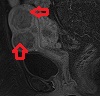
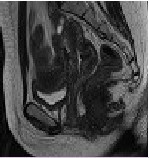
Fibroids before UFE

Fibroids before UFE

Stated simply, UFE is the injection of biocompati- ble particles into the arteries supplying the uterus to obstruct the flow of blood to it. A small catheter the size of spaghetti is inserted into an artery in the groin or the left arm and advanced into the uterine arteries. Particles of variable sizes are injected into the arteries to block them and kill the fibroids, not the uterus.

The advantages of UFE include:

  1. It is safe and effective.
  2. It requires no general anesthesia and can be quick.
  3. It requires short or no hospitalization.
  4. It stops or decreases heavy menstrual bleeding and cramping in most patients.
  5. It decreases the uterine volume.
  6. It permits early return to work and usual lifestyle.
Fibroids during UFE

Fibroids during UFE

Fibroids 12 months after UFE

Fibroids 12 months after UFE