

Author Archives: Ken Ekechukwu

Hemodialysis Access Management: Case 2 Ken U. Ekechukwu, MD, MPH, FACP.

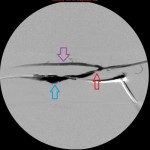
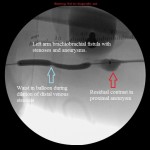
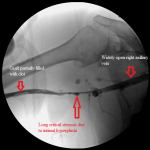
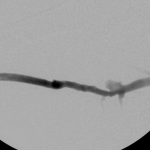
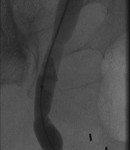
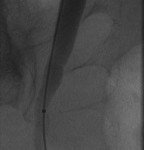
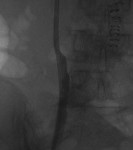
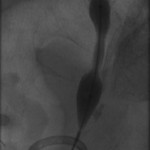
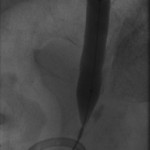
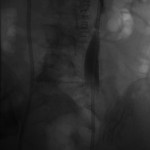
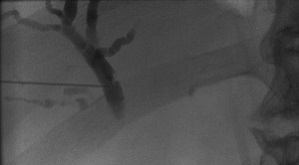
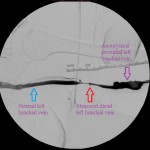
These 3 images are diagnostic angiograms of a left arm arteriovenous fistula (AVF) between the brachial artery and the brachial vein. The end of the proximal left brachial vein (the part of the vein closer to the elbow) was anastomosed to the side of the distal left brachial artery at the creation of the fistula and the stump of the vein ligated.

The study is more appropriately named a fistulagram and shows that the left brachial artery and the arteriovenous anastomosis are normal, with an abnormal venous limb of the circuit: the venous limb has a short juxta-anastomotic stenosis separated from 2 juxtaposed saccular aneurysms by a short segment of normal vein; distal to to the aneurysms is a smooth tapering stenosis that merges into a normal segment of the vein. The rest of the brachial vein, the axillary vein, and the central veins are normal, but the images are not included in the gallery. Notice that a complete picture of the arterial and venous limbs of the circuit was obtained by injecting radiocontrast through the sheath between the aneurysms and the juxta-anastomotic stenosis, suggesting high intravenous pressure proximal to the stenosis in the mid brachial vein.

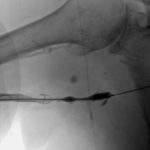
To fix the problems, I punctured the vein proximal to the aneurysms and secured the access with a sheath. I passed a balloon over a guidewire to the distal stenosis and dilated it with optimal outcome. I secured a second access through the normal segment of the vein distal to the stenosis (pointing towards the patient’s elbow) and through it advanced the balloon to the juxta-anastomotic stenosis. I dilated it with optimal outcome. I did not address the aneurysm at the same session, but placed it under periodic clinical and imaging observation. The final fistulagram showed rapid blood flow through the venous outflow limb with satisfactory calibers at the treated segments.

The natural history of situations such as this is that the flow of blood through the fistula gradually slows down as the stenoses worsen, coming to a full stop when the obstructions complete. Clot forms and the access fails. Warning clinical signs of impending failure include prolonged dialysis times, diminished venous flow rates, high static venous pressures, prolonged bleeding at needle entry site upon removing the dialysis needle, a string of clot adherent to the needle at withdrawal, water-hammer pulse over the segment of the vein proximal to the stenosis that diminishes as the stenosis worsens, a thrill of variable strength, and a harsh murmur amongst others. It is at this time that patients should be referred for diagnostic fistulagram, not when the access fails. It costs more in money, effort, time, and patient morbidity to salvage thrombosed dialysis accesses than intervening on malfunctioning but patent ones. The outcomes are also poorer .

Arterial limbs of dialysis accesses are not as problematic as their venous limbs, which are often plagued by stenoses and aneurysms. The latter are caused by iatrogenic venous injury during surgical creation of the access and repeated punctures at dialysis and during diagnostic and surveillance imaging. They occur less frequently or develop slowly when such punctures are rotated over the skin overlying the vessel.

Stenoses are easily treated with balloon dilation, while aneurysms may be observed over time for growth. They should be repaired surgically or be endovascularly isolated from the circulation with covered stents, when the threat of their rupture rises or they become reason for repeated failing of an access.
Hemodialysis Access Management: Case 1. Ken U. Ekechukwu, MD, MPH, FACP.

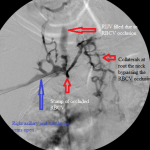
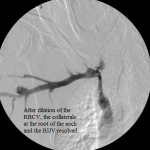
These images illustrate managing peripheral and central venous stenoses associated with a thrombosed hemodialysis access.

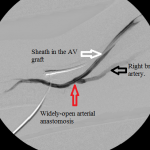
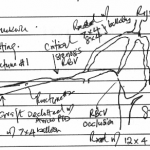
They belong to a patient whose graft failed the day after his last hemodialysis. The line diagram is a composite illustration of the anatomy of the graft, the deep veins of the upper right arm, the central veins, observations I made during the intervention, and the materials I employed in the treatment.

The graft is a straight polytetrafluoroethylene graft anastomosed to the distal right brachial artery and the mid right brachial vein. It had neither pulse nor thrill on clinical examination, suggesting it was thrombosed. There were multiple dilated veins on the patient’s upper right chest indicating central venous stenosis.

I established access into the upstream segment of the graft, close to the arterial anastomosis, pointing towards the patient’s head, and centrally advanced a 4 French angled catheter over a stiff glide wire towards the superior vena cava.

I ran into a resistance in the mid right arm that I overcame and an obstruction behind the head of the right clavicle that stopped me in my tracks. I obtained pullback venogram that confirmed these to be due to a long critical stenosis of the mid right brachial vein, immediately distal to the anastomosis of the graft to the vein, and total chronic occlusion of the right brachiocephalic vein, respectively. The latter was associated with numerous ipsilateral and contralateral venous collaterals at the root of the neck as well as refluxing of radiocontrast up the right internal jugular vein.

I mechanically thrombectomized the graft with the Arrow-Trerrotola PTD device inserted through the first access and a second access I established in the distal end of the graft, pointing towards the patient’s hand. 

Then I dilated the brachial venous stenosis and probed through and dilated the right brachiocephalic vein. The brachial venous dilation proved optimal, but there was residual stenosis of the RBCV that I resisted stenting at the same setting. 

With a balloon inflated at the mid brachial stenosis, I injected radiocontrast through the sheath in the proximal end of the graft, forcing contrast-laden blood to flow back across the arterial anastomosis. This revealed a focal juxtanastomotic stenosis, but not abnormalities of the arterial limb of the circuit. I dilated this second stenosis with optimal outcome.

Though I considered the RBCV disease a threat to the access, I chose to observe the access over time and delay stenting the stenosis for the following reasons:

  • The presence of collaterals associated with it suggested that it was not the immediate cause of the graft failure. The collaterals must have provided sufficient pathways of central venous return that allowed optimal venous flow through the graft and normal intra-graft pressure, critical elements in preventing acute graft thrombosis. The most proximate causes of failure of the graft were the juxta-anastomotic stenosis and the critical stenosis of the mid right brachial vein.
  • There was no associated swelling of the right upper extremity after I restored function to the graft nor was there any when the patient returned for follow-up at my clinic, proving that the increased blood flow allowed by the plastied mid brachial vein stenosis and the juxta-anastomotic stenosis had sufficient pathways to return to the right atrium without elevating the intragraft pressure unduly.
  • Similarly, the sustained thrill and pulse I established after the interventions on the first day were still present when the patient returned for follow-up.

At the time of this writing there is ongoing debate about treating central venous stenoses in patients with failed AVF or AVG, because their role in the failure of these accesses is unclear. Some accesses, as in this patient, seem to tolerate their presence well, while others do not. It seems to me that central venous stenoses that have well-developed collaterals that drain the upper limb well compensate for their lost utility, while in those with little or no collaterals their resistance to the forward push from the arterial limb of the circuit raises intragraft pressure sufficiently to slow down flow through the access and ultimately force it to fail. 

Internal stenting of the left ureter Ken U. Ekechukwu, MD, MPH, FACP.

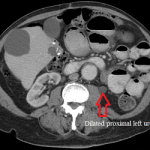
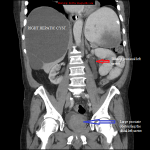
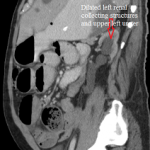
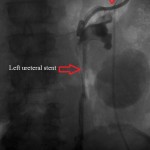
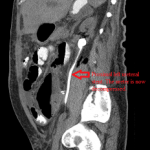
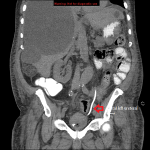
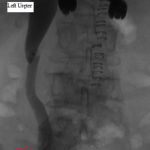
These images illustrate the benefit of ureteral stenting. They are of a male patient with benign prostatic hypertrophy, who recently underwent surgical resection of a colonic malignancy. His imaging workup uncovered left hydronephrosis caused by a retroperitonal mass encasing his distal left ureter. It was not possible stent the ureter from a urethral approach, so he was referred to the interventional radiology service.

Using ultrasound, a needle was inserted into a dilated mid-pole calyx, and an antegrade pyelogram obtained through a sheath inserted to secure the access confirmed marked dilation of the left ureter and the collecting structures of the left kidney. Ureteral stent was deployed over a guidewire passed across the distal ureteral stricture into the urinary bladder and its proximal and distal pigtail loops reformed in the bladder and the left renal pelvis, respectively. A capped rescue nephrostomy catheter was left in the renal pelvis, but was removed later, when the ureteral stent proved sufficient in decompressing the left urinary collecting system.

As I discussed elsewhere, it is important that an obstructed renal collecting system be relieved or the urine accumulated above it and under pressure be drained as soon as possible to avoid renal damage and infection. Optimal relief of such obstruction is with an internal ureteral stent placed through the urethra by a urologist. But when this is infeasible, the stent can be placed antegradely from the back and through the kidney. When successful, a rescue nephrostomy catheter may be left in place, capped, until it is certain that the stent is working well – unless there is no reason to worry about the stent functioning well. The nephrostomy catheter may be removed in 24 hours – 48 hours, barring any contraindications.

Bilateral insertion of nephroureteral stents after balloon dilation of malignant obstruction of the distal ureters. Ken U. Ekechukwu, MD, MPH, FACP.

The above images belong to a middle-aged woman with cervical cancer, who developed impaired renal function when the cancer  invaded and obstructed her distal ureters. Efforts by urologists to stent her ureters from below through her urethra failed, because the ureteral orifices were invisible. She was referred to the interventional radiology service for ante-grade intervention through the kidneys. Because she was prone on the table for the procedure, there is seeming reversal of her right and left sides.

Access was gained from the back into a dilated posterior calyx of each kidney and secured with a sheath. Antegrade pyelogram on each side revealed marked ureteral  and calyceal dilation due to complete obstruction of the distal ureter. A wire was advanced into the urinary bladder past the obstruction, which was dilated with a non-compliant balloon when it resisted the deployment of a nephroureteral stent. The stent was successfully deployed after the balloon dilation.

The ureters can be obstructed by benign and malignant disease in or outside them. When this happens, the flow of urine is disturbed, slowly progressing from delayed emptying of the ureters to complete cessation of flow into the urinary bladder.

Pressure rises in the collecting system above the obstruction as urine accumulates above it. If the obstruction is not relieved or the upper urinary tract not decompressed, the increased pressure impairs renal function and ultimately stops urine production.  The resulting retention of water and the impaired elimination of waste products of metabolism sicken the patient and may prove lethal. In addition, the stagnant urine may become infected, leading to sepsis that may overwhelm the patient.  For these reasons such obstructions must be relieved or the accumulated urine drained. 

Ureteral obstructions are best managed by urologists, but when they prove high-grade and urologically non-crossable, an interventional radiologist can approach them by passing instruments from the back, through the kidneys, past the obstructions, into the urinary bladder using imaging guidance while the patient is sedated.

If obstructions are easy to cross, internal ureteral stents may be placed across them, with one end of the stent in the renal pelvis and the other in the urinary bladder. The stents should be changed periodically through the urethra by urologists or interventional radiologists. Sometimes, as in the patient whose images are displayed above, the obstruction must be predilated to permit insertion of the ureteral stents. Alternatively, a drainage catheter called a nephrostomy catheter can be deployed into the renal pelvis to drain urine into a bag attached to it without crossing the obstruction.

Internal ureteral stents are preferable over nephroureteral stents, which are also placed by interventional radiologists but differ from ureteral stents in having their proximal segments outside the patient, so that urine not only drains down their internal segment into the urinary bladder, but is also diverted into a bag attached to the hub of their external proximal end.  They differ from nephrostomy catheters in having an internal component continuous with their external component and that runs down the ureter to the urinary bladder.

Nephrostomy catheters and nephroureteral stents are indicated in patients with total urinary incontinence, because with them not all the urine made by the patient flows into the urinary bladder; some is diverted externally. In total urinary incontinence, which can be caused by multiple disorders, the patient is constantly wet with urine escaping past an incompetent bladder neck or across an abnormal connection between the urinary tract and the vagina. Nephroureteral stents and nephrostomy catheters are also easier to exchange by interventional radiologists, but come with the nuisance that the patient has to manage their external component.


Case 1: Bilateral percutaneous biliary drainage for obstructive jaundice due to cholangiocarcinoma. Ken U. Ekechukwu, MD, MPH, FACP.

History: An 87-year-old man was admitted to a hospital because of jaundice. He was found to have conjugated and unconjugated hyperbilirubinemia, the former more than the latter. His cross-sectional imaging revealed marked dilation of his extra-hepatic and intra-hepatic bile ducts that proved inaccessible at endoscopic retrograde cholangiopancreatography (ERCP). He was referred to interventional radiology for percutaneous biliary drainage, where the decision was made to percutaneously drain the biliary tree.

Intervention: Following adequate prophylactic antibiotic coverage against septicemia and under monitored-and-controlled anesthesia, a 22 gauge needle was blindly introduced into a branch of the right hepatic duct under fluoroscopy and confirmed by cholangiogram, Fig.1.

Fig. 1: Right hepatic cholangiogram through a 22 gauge needle introduced percutaneously from the right flank.

The needle was replaced with an AccuStick set over a guidewire through which a cholangiogram was repeated, revealing  severe stricture of the distal right and left hepatic ducts as well as the common hepatic duct, Fig 2.

Fig. 2: Percutaneous cholangiogram through an AccuStick sheath in the proximal right hepatic duct.

Guide wires were advanced from accesses in the right flank and the epigastrium through the right and left hepatic ducts, respectively, past the common hepatic into the duodenum preparatory for inserting drainage catheters, Fig.3.

Fig. 3. Guide wires introduced through the hepatic ducts into the duodenum preparatory for catheter drainage.

GP_guidewires in the right and left hepatic ducts.

Balloons were passed over the guidewires to dilate the narrow tracts and an 8 French biliary drainage catheter was inserted into each tract. The cholangiograms through the catheters confirm optimal placement and marked decompression of the tracts, except the left hepatic duct, which still contained filling defects, Fig. 4. The patient did well after the procedure, but died before a histologic diagnosis was available. The final diagnosis was cholangiocarcinoma.

                             Fig.4. Post-procedure right and left cholangiograms through drainage catheters placed to decompress malignant biliary obstruction.

Fig. 4. 8 French drainage catheters inserted through the right and left hepatic ducts. Note that the ducts are decompressed, except the left hepatic duct which remains full of filling defects that may be clot, tumor, or stones.