

Author Archives: Ken Ekechukwu

Percutaneous biopsy. Ken U. Ekechukwu, MD, MPH, FACP.

What is percutaneous biopsy?
Per means ‘through’ in Latin, ‘cutaneous’ derives from cutis, which is Latin for skin. Bio- is a combining form from the Greek word bios, which means life and opsis is Greek for vision. Percutaneous biopsy then, is the removal of living tissue through the skin, usually with a needle. Tissue can be taken from any organ for analysis and the procedure is frequently an outpatient one. By comparison, in open biopsy a tissue or organ is laid bare, and the operator, under direct view removes a portion or all of an abnormality; removing a part of abnormal tissue is called incisional biopsy, while removing the entire abnormality is excisional biopsy. In both, because of their complexities, the patient is sedated deeply and may even receive general anesthesia.

How is percutaneous biopsy done?
There may or may not be arrangements for you to stay in the hospital or clinic for observation after percutaneous biopsy. This is safe and allows your care provider to detect any complication(s) early and manage them. This aspect of care varies with physicians, a patient’s overall health and the complexity of the biopsy process. You will, quite likely, be asked not to take anything by mouth starting the midnight of the day of your procedure. This allows your physician to expeditiously administer conscious sedation to you should there be need to do so during your biopsy. The procedure is, however, relatively simple and safe and most operators do it with only local anesthesia, allowing the patient early discharge. You may also be asked or have been advised to cease taking such medications as Warfarin (Coumadin), Aspirin and Ibuprofen since these “thin” the blood, raising your chance of bleeding after the biopsy.

Several decades ago percutaneous biopsies were done blindly, meaning that operators were guided by a sound knowledge of anatomy of the body when biopsying deep body organs; it was and still is easy to biopsy palpable lesions because they are superficial and easily accessible. Blind biopsies in those days were generally done when diffuse involvement of an organ seemed likely, not when there was a nonpalpable focal lesion like a tumor; such would need an open biopsy (excisional or incisional). Today, because of technological advances in medicine, most percutaneous biopsies are done with guidance from imaging modalities like fluoroscopy, ultrasound, CT scan and magnetic resonance imaging (MRI), which eliminates guess work from the procedures, making them safer. You will be asked to lie down, the site of disease reviewed again with an imaging modality, and an appropriate skin entry point selected, cleansed with antiseptic material, and anesthetized. The operator will then make a small nick in the skin with a surgical blade and, through it advance a needle of appropriate size and length, into the numbed track down to the area of interest and remove a few bites of the tissue. He will remove the needle and hold pressure over the biopsy site to arrest mild bleeding that may occur.

How do I prepare for percutaneous biopsy?
First, you or a designee must ask of and receive from your care provider an account of the merits and demerits of this procedure and its alternatives. When you have done this, you must endorse the procedure by signing a document called a consent form. You will inform your physician of and stop taking any of the medicines mentioned above that place you at risk for bleeding.

Who needs percutaneous biopsy?
1. Anyone who has a lesion or disease whose diagnosis is unknown despite other investigations.
2. Anyone with an established disease whose effect on an organ requires monitoring through periodic microscopic reviews of tissue from the organ. For example, patients with hepatitis C virus infection of the liver need be monitored to know when the infection requires treatment.
3. Anyone with a symptom or sign that suggests disease of a specific organ that demands characterization and staging scheme. For example, patients who spill protein in their urine in whom the nature of the underlying kidney disease is best framed by microscopic review of renal tissue.
4. Any other reason(s) your physician may explain to you.

What are contraindications to percutaneous biopsy?
Contraindications are conditions you may have that will make percutaneous biopsy  risky for you. You must let your healthcare provider know of them before embarking on this procedure. They include:
1. Uncorrectable coagulopathy (this means ‘thinning’ of your blood which will make you bleed too much). 
2. No safe access route.
Fractures of the temporal bone. Ken U. Ekechukwu, MD, MPH, FACP.

History
This was a young female victim of a fatal motor vehicle accident.

Radiologic findings

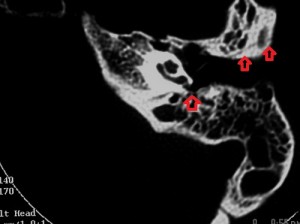
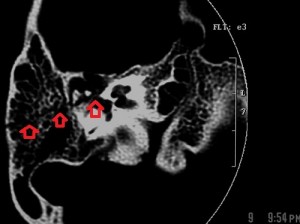
Right_temporal_bone_fracture Left temporal_bone_fracture

Images A and B are bone-window axial sections of the petrous portions of the right and left temporal bones taken at slightly different levels. Both show longitudinal fractures of the petrous pyramids with slightly different orientations (see the arrows). In addition, there is a fracture line through the anterior right basi-occiput, arrowed on image B.

On the right, the fracture line extends into the right middle ear, across the tegmen tympani and into the middle cranial fossa while on the left it stops at the external auditory meatus. The right ossicular chain is dislocated (incudostapedial joint) but the left chain and the right and left otic capsules are preserved. There is effluent in the right mesotympanum, the reason for a right ottorhea at presentation. There is no fluid in the left middle and external ear. Although the images are not included, there are no injuries to the internal auditory canals

Radiologic diagnosis
1. Longitudinal fractures of the right and left petrous pyramids with right ossicular chain dislocation.
 2. Fracture of the anterior basi-occiput.

Discussion
This patient died from other severe body injuries including at least two variants of injury to the skull base – petrous pyramidal fracture and fracture of the basi-occiput. I will dwell on the pyramidal fractures.

Fractures of the petrous pyramids are one of the most common fractures of the base of the skull (the others are fractures of the sphenoid bone, the orbital roof and the basi-occiput).

Petrous pyramidal fractures are due to lateral, frontal or occipital forces to the head and may be longitudinal (parallel to the long axis of the petrous pyramid) or vertical (perpendicular to its long axis). Although the longitudinal pattern is thought commoner (80%), the majority of the injuries are mixed.

Typically inflicted by a tempo-parietal blow, the longitudinal fracture (as in this case) begins from the squamous portion of the temporal bone and the mastoid, travels through the external meatus, passing medially to the tegmen tympani. The middle ear is involved, along with ossicles in some cases; the CT images show opaque mastoid air cells, fluid in the mesotympanum and ossicular fracture or dislocation.

Clinically, there is bleeding from the external meatus, conductive hearing loss, and leakage of CSF from the ear or the mouth (via the Eustachian tube).  When the fracture line extends medially, it may either be deflected by the bony labyrinth (which is relatively resistant to fracture), or traverse it, resulting in facial nerve weakness (due to edema), with a favorable prognosis, as well as variable degrees of deafness and vestibular impairment. If there is a fracture of the labyrinth, pneumolabyrinth may occur. When the fracture line travels close to but spares the bony labyrinth, the seventh and eighth cranial nerves may suffer temporary concussional effects (sensorineural deafness, dizziness, balancing problems).

Pure transverse fractures of the petrous pyramid are less common (20% of the fractures) and result from either occipital or frontal forces to the skull. The fracture line travels perpendicular to the long axis of the pyramid. It commonly extends forwards from the jugular fossa or foramen magnum across the temporal bone either through the bony labyrinth or more medially through the internal auditory canal, and severe or complete sensorineural deafness with vestibular paralysis is a common feature. In such patients cochlear implantation may be attempted.

Fractures of the base of the skull may present in various ways depending on the pattern of injuries. Peri-orbital ecchymosis, the raccoon eye, is due to a fracture of the orbital floor; CSF rhinorhea is due to a fracture of the floor of the anterior cranial fossa or may be due to a fracture of the body of the sphenoid bone. Blood or CSF leakage through the mouth (via the Eustachian tube) or the external auditory meatus suggests injury to the floor of the middle cranial fossa (tegmen tympani). William Henry Battle, a British surgeon, described as a sign of basilar skull fracture, skin discoloration in the line of the posterior auricular artery which first appears near the tip of the mastoid process.

There may be conductive hearing impairment due to dislocation or fracture of the middle ear ossicles (these may occur with or without petrous pyramidal fractures) or sensorineural hearing loss due to injury to the inner ear hearing structures or the eighth cranial nerve. The face may droop because of injury to the facial nerve (temporary or permanent) while vestibular injury causes dizziness, vertigo, nausea or vomiting. When your suspicion is aroused, investigate the patient with CT, a good imaging modality for this purpose, to confirm and explore the extent of the likely injuries.

References
1. Yeakley JW.     Temporal bone fractures.     Curr Probl Diagn Radiol. 1999 May-Jun;28(3):65-98.
2. Hasso AN, Ledington JA.     Traumatic injuries of the temporal bone.     Otolaryngol Clin North Am. 1988 May;21(2):295-316.
3. Samii M, Tatagiba M.     Skull base trauma: diagnosis and management.     Neurol Res. 2002 Mar;24(2):147-56. Review.


Limb-saving interventions. Ken Ekechukwu, MD, MPH, FACP.

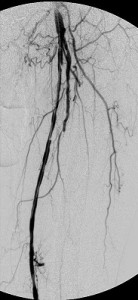
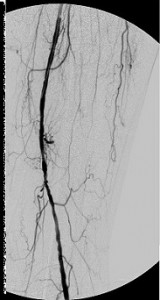
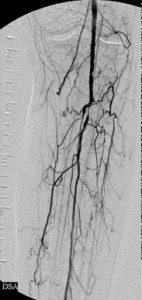
Multifocal_disease_LCFA_LSFA_LPOPA_proximal_pre Multifocal_disease_LCFA_LSFA_LPOPA_mid_pre Multifocal_disease_LCFA_LSFA_LPOPA_prox leg_before Multifocal_disease_LCFA_LSFA_LPOPA_distal leg_before
Multifocal_disease_LCFA_LSFA_LPOPA_proximal_post Multifocal_disease_LCFA_LSFA_LPOPA_mid_post Multifocal_disease_LCFA_LSFA_LPOPA_distal leg_before

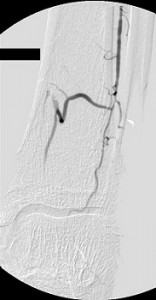
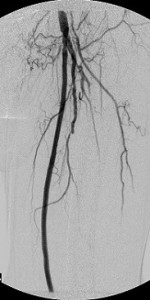
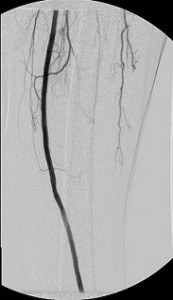
These images illustrate efforts to save a limb from amputation, or, at least delay the event, when the limb is threatened by severe diabetic angiopathy and a non-healing ulcer. 
 
Neuropathy and vasculopathy due to diabetes substantially contribute to limb loss all over the world, which in turn reduces an amputee’s longevity. Revascularization of chronic total occlusions (CTOs) or severe but non-occlusive arterial disease of the lower extremities has revolutionized the management of the diabetic foot and primary care givers and podiatrists commonly seek out vascular specialists skilled in endovascular treatment of such flow impediments when confronted with patients on the verge of losing their limbs to them. Even if limb amputation is unavoidable, such interventions may limit the extent of amputation.
 
The images in the top panel illustrate multicentric moderate and severe (>50%) narrowings of the proximal left common femoral artery (LCFA) – not shown – and the superficial femoral artery and a focal critical stenosis of the proximal left tibioperoneal trunk in an elderly diabetic man with a chronic ulcer of his left foot. Notice that the critical tibioperoneal stenosis limits blood flow into the patient’s only named branch of his left popliteal artery, the peroneal artery, which is the principal path of blood inflow to the foot. Note, too, the severity of the lack of perfusion of the foot as shown by the “whiteness” of the patient’s hind foot.
 
It was , therefore, helpful to the patient that I eliminate as much of the upstream disease as was feasible and dilate the critical stenosis of the left tibioperoneal trunk. Thus, balloon angioplasty was applied to the common femoral obstruction and the tibioperoneal trunk stenosis and a stent-graft was used to exclude from the circulation all the superficial femoral arterial disease. The bottom panel of images shows the immediate outcome of these interventions. The ulcer eventually healed.

Stenosis of the left iliac artery. Ken U. Ekechukwu, MD, MPH, FACP.

Smoking, dyslipidemias (disorders of lipids such as hypercholesterolemia), hypertension, and diabetes, individually and severally, may narrow or occlude arteries in all parts of the body.

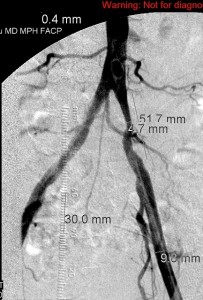
Amongst arteries that may suffer are the ones that carry blood from the abdominal aorta (the large artery that carries blood from the heart across the abdomen towards the lower limbs) through the pelvis (the waist area) into the lower limbs, called the iliac arteries. If the narrowing of the vessel lumen is significant or the occlusion total, symptoms like claudication (pain during ambulation), paraesthesia, numbness, and erectile dysfunction may develop and bring a patient to medical attention. (Arterial stenoses usually cause symptoms (see above) when they reduce the diameter of affected vessels by more than 50%, corresponding to loss of 75% of their surface area.)

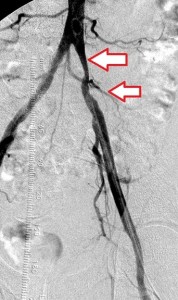
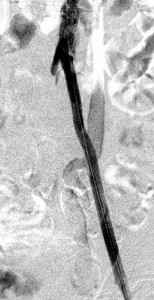
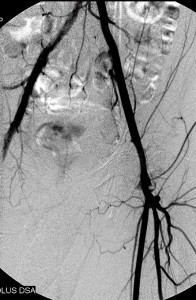
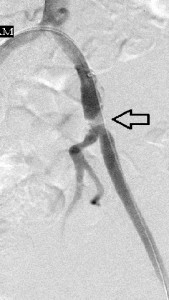
The images below illustrate percutaneous stenting of stenosis of the distal proximal and the mid left common iliac artery, without disease of the left external iliac artery in one of my patients who presented with left calf claudication. CTA of his abdominal aorta and arterial duplex ultrasound of his lower limbs ( images not shown) revealed left iliac  stenosis, confirmed by the digital subtraction angiographic images in the first row. He did well following stenting of the diseased artery.  Iliac arterial stenting stays open for nearly as long as surgical revascularization and at much less the morbidity and cost of the latter.

 Left_iliac_stenting_pre_2Left_iliac_stenting_pre_1
Lt_iliac_stenting_post_1 Left_iliac_stenting_post_2


Blue toe syndrome of the left great toe. Ken U. Ekechukwu, MD, MPH, FACP

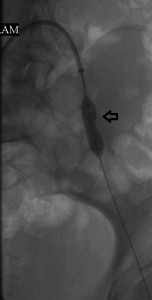
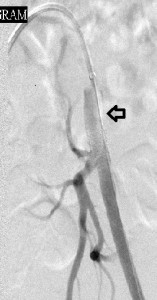
Focal_left_common_femoal_stenosis_before_stenting Focal_left common_femoal_stenosis_at_stenting Focal_left common_femoal_stenosis_after stenting

The blue toe syndrome results when the arterial supply to a digit of the foot is acutely interrupted. Since digital arteries are end arteries and the interruption sudden, the affected toe quickly develops ischemia, which manifests as acute pain and discoloration. Often the obstructing agent is a fragment of clot dislodged off diseased segments of the upstream arterial tree – the heart, the aorta, the iliacs, or the femoropopliteal segment. The primary disease may be luminal thrombosis or thrombus in an aneurysmal sac or a left heart chamber. Occasionally, usually in the setting of endovascular interventions, it may be a cholesterol crystal broken off a mural plaque, a more obstinate problem to treat than embolized blood clot. It is reasonable, therefore, in the patient with the blue toe syndrome that the care giver investigates their arterial paths from the heart to the toes and consider as well the possibility of a hypercoagulable state.

I present here a young woman whose primary care physician referred to me because of acute pain in her left great toe that was associated with discoloration. Her left common femoral pulse was diminished on examination and its waveform abnormal on arterial Doppler sonography. The image to the far left of the reader shows a focal filling defect of the distal left common iliac artery with sharp margins between its upper and distal surfaces and the vessel lumen, a calcified plaque from which a small embolus may have arisen. The rest of her angiography was normal. The middle image shows the deployment of a short balloon-expandable stent across the filling defect, while the image to the reader’s right is the post-intervention study that shows restoration of normal blood flow through the left iliac channel. Her symptoms resolved and she returned to her primary care provider on aspirin, Plavix, and advice to quite smoking, while pursuing hypercoagulability workup with him.